What you are: a creditor or an owner?
The moment you deposit coins on a centralized platform, you hand over an asset and get a database entry back. In legal terms that entry looks more like an IOU than a title deed.
You can't tell the difference day to day; in a good market the two work exactly the same. It only shows up on the day the platform gets into trouble: an owner can say "give me back my share," while a creditor can only say "this is how much you owe me." The first stays out of the bankruptcy estate. The second gets shared out pro rata with every other creditor.
Which side you land on doesn't depend on the platform's marketing. It depends on what the user agreement says, which jurisdiction the platform is registered in, and whether customer assets are actually held separately — and none of those three things appears anywhere in the app. In most jurisdictions the order of repayment runs roughly: secured claims, then administrative costs and statutory priority claims, then unsecured claims, then shareholders. Ordinary users usually sit in the unsecured tier, and the way insolvency laws rank claims varies a lot from country to country.
Your balance and the coins on-chain are not the same thing
Almost nothing you do inside a platform touches the blockchain. Buying, selling, moving funds between accounts and internal transfers are, at bottom, the platform editing numbers in its own database. The only thing that creates an on-chain transaction is a withdrawal. Deposited coins are normally swept into a handful of wallets the platform manages centrally, where they sit mixed with everyone else's — this is commingling. On-chain you just see one large pile of assets, with nothing marking which part belongs to whom.
That design isn't a conspiracy; it's a trade-off for efficiency. Putting every internal trade on-chain would be unworkable on both fees and speed. But the cost is real: you cannot use on-chain data to prove "my share is still there." Once assets are commingled, a court also struggles to say which coin belongs to whom, so the whole pool usually goes into the bankruptcy estate and is then divided in proportion to claims.
Conversely, only coins in a wallet where you hold the private keys are yours in the on-chain sense. That doesn't mean "everyone should self-custody." Self-custody swaps counterparty risk for operational risk: nobody can recover a lost seed phrase, and there is no support desk to appeal to if you send funds to the wrong address. The two risks are different in kind, and you should be clear about which one you are carrying.
What actually happens after a bankruptcy filing
The process is more formal than most people imagine, and a great deal slower. It isn't a one-liner like "the platform ran off and the money is gone"; it's a court procedure with fixed stages and statutory deadlines:
- Signs of a liquidity squeeze appear first: withdrawals slow down, withdrawals of certain coins are paused, announcements get vague. None of these means much on its own — maintenance and risk controls can look exactly the same.
- The platform itself, or its creditors, files with a court, and the case enters bankruptcy, reorganization or liquidation proceedings.
- Trading and withdrawals are normally frozen, and account balances are fixed as of a certain point in time. From here on, there is nothing you can do in the app.
- The court appoints an administrator, trustee or liquidator to take control. The old support team and app are no longer your counterparty; the person you deal with now is that administrator.
- The administrator sets up a public case website that publishes case documents, notices, a portal for filing claims, and the claims deadline.
- Users submit their claims with supporting documents, the administrator reviews them, and there may be rounds of objections and corrections.
- The court approves a distribution plan and payouts begin, usually in several rounds.
The claims deadline in step five (usually called the bar date) is where ordinary users most often get caught out. Miss it and your claim may not be recognized, or you may have to go through a separate procedure to fight for it. That date only appears on the administrator's website and in court notices. It won't be pushed to your phone — the app that used to send you notifications has already shut down by then.
The whole process runs on a timescale of years, not weeks, and in the meantime the assets can be neither traded nor moved. One more thing beginners often miss: filing a claim is not a matter of writing "I had this many coins." You need documents that prove your balance and that the account is yours — and if you only start looking for them at that point, you often can no longer log in.
Which day's price sets the value of your claim
This is the point that hurts most afterwards and gets discussed least beforehand: many bankruptcy proceedings convert claims into a fiat amount as of the day the petition was filed. Whatever the coin price does after that has nothing to do with the size of your claim.
Put another way: say you had one BTC in your account on the filing date. Your claim is quite likely to be recorded as "what one BTC was worth in fiat on the filing date," not as "one BTC." When distributions happen years later, even if the price has multiplied several times over, what you receive is still a pro rata share calculated on that old amount. The coin is the same coin, but it is no longer part of your claim.
There is a procedural logic to this: if you have to divide claims across hundreds or thousands of different assets in proportion, you have to freeze valuations at one fixed point. Traditional bankruptcy cases work the same way; it isn't a special rule aimed at crypto. For coin holders, though, the consequence is blunt. If the platform happens to fail near a market low, your claim is locked in at that low, and repayment often comes years later. That gap is very real, and it is not something the court will weigh on your behalf.
In any given case, how the valuation date is set and whether there are exceptions depends on which law applies and what plan the court approves, and cases differ considerably. Don't treat one case's approach as a universal rule, and don't count on anyone warning you about it in advance.
What proof of reserves can and can't prove
The conclusion first: proof of reserves (usually shortened to PoR) shows that "there were assets on the books at a certain moment." It does not show "there are no liabilities," nor that "these assets weren't pledged or borrowed." It's a snapshot, not an insurance policy.
| Common approach | What it can show | What it can't show |
|---|---|---|
| Merkle tree proof of reserves | How much the addresses the platform says it controls held at the snapshot time; users can check whether their own balance was included in the total | How large total liabilities are, or whether the platform is insolvent |
| Signatures proving address control | That the signer controlled those addresses at a given moment | Whether the assets were temporarily borrowed, or have been pledged or rehypothecated |
| Third-party verification report | Depends on its scope and how the conclusion is worded — many are agreed-upon procedures (AUP) reports, not a full audit opinion | Related parties outside the report's scope, off-balance-sheet liabilities, and the position at any later date |
| Reserve proof that includes liabilities | How assets compared with user liabilities at the snapshot time — far more meaningful than disclosing assets alone | Any moment outside the snapshot; the figures still rely on what the platform reports about itself |
The biggest blind spot of PoR is time: it is a single photo, not continuous monitoring, and what happens between two snapshots is invisible from outside. To judge whether a PoR carries weight, three questions are enough: does it include liabilities, how often is it done, and who issued it and how is the conclusion worded?
More practically: don't read a published PoR as a "safe" label, and don't read the lack of one as a "dangerous" label. It is a piece of information you can check — not a rating, and certainly not a promise.
What you can do before anything goes wrong
Each of these takes a few minutes on an ordinary day and is almost impossible to make up for afterwards. None of them is aimed at any particular platform; they are aimed at the simple fact of keeping your assets concentrated with a single counterparty.
- Don't leave large amounts with one custodian for long. Keep what you need for day-to-day use, and move the rest to a self-custody wallet or spread it across different counterparties. This is a judgment about structure, not about any one company.
- Export your records regularly. Trade history, deposit and withdrawal records and statements: export them as CSV or PDF every quarter, and keep one copy locally and another somewhere else. By the time you need to file a claim, you may no longer be able to log in.
- Keep your on-chain evidence. The txid of every deposit, screenshots of transfers, and deposit addresses. On-chain records are the hardest to dispute, because they don't depend on whether the platform's database can still be opened.
- Save your account-opening and KYC submission records. When you submitted, which documents you sent, and the approval email. Filing a claim usually starts with proving the account is yours.
- Spread across genuinely different counterparties. Two accounts on the same platform, or spot and futures accounts at the same company, count as one counterparty in bankruptcy proceedings. The point of spreading out is to spread the risk of "this one fails," not to have more accounts.
- Keep an email address you'll still be using years from now. Many notices from administrators and courts go out by email. Phone numbers change; use an email address you can keep indefinitely.
- Read those few clauses in the user agreement. Who owns the assets, whether customer assets are segregated, and which country's law and which court apply. It's dull, but after a failure those few lines decide which tier you stand in.
Start with two of these: exporting your records and keeping your on-chain evidence. Set a quarterly reminder once and it keeps working. Where to keep your assets is a bigger decision, and you can take your time over it.
Two cases that went to court
Both of the following are historical cases that have entered court proceedings with public records, used here to show what "years" really means.
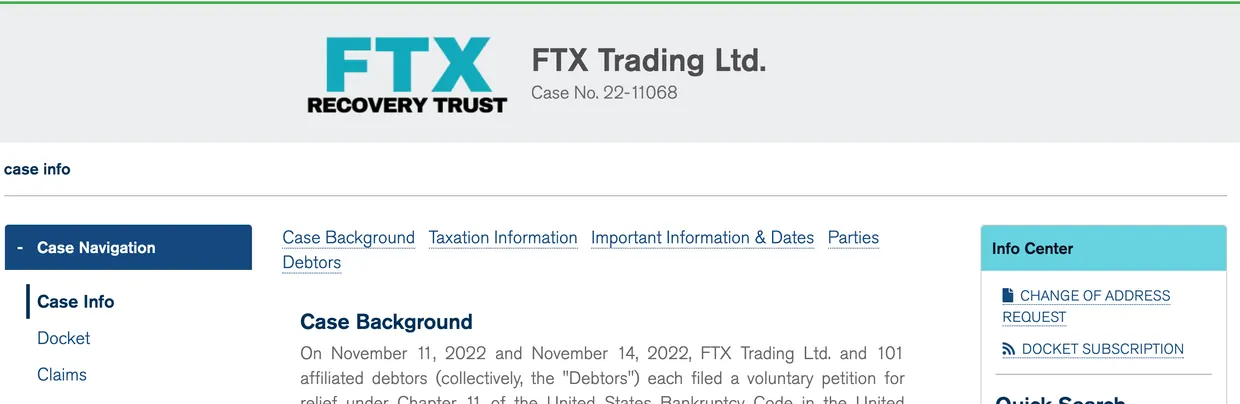
FTX. Filed in November 2022 under Chapter 11 of the US Bankruptcy Code with the Delaware bankruptcy court, case number 22-11068. The public case website, run by Kroll Restructuring Administration, is where case documents, notices and the claims filing portal all live — the screenshot in this article is that site. What users had to do changed from "contact support" to "file a claim on the case website before the deadline."
Mt.Gox. Ceased operations and entered bankruptcy proceedings in 2014, then moved to civil rehabilitation proceedings in Japan on June 22, 2018, overseen by rehabilitation trustee Nobuaki Kobayashi. As of our last check, the official announcements page showed the deadline for the Base Repayment, Early Lump-Sum Repayment and Intermediate Repayment extended to October 31, 2026, from the previous October 31, 2025. Counting from when it stopped operating, the case has run for more than ten years, and the deadline is still being pushed back.
Taken together, the two cases show two things: the timescale really is years, not months; and your relationship with the platform changes character on the day of the filing, after which everything moves at the court's pace. To be clear, this article cites only the public records of historical cases. It does not assess the solvency of any platform still operating, and it does not predict who will fail next.
In the end, this isn't a prediction that anyone will fail. It's common sense for the "just in case" — the same way buying a fire extinguisher doesn't mean you expect your home to burn down. Export your records, move the large amounts, read the agreement once: when nothing goes wrong, the cost is a few minutes; on the day something does, they are the only things you have in hand.
Sources and where to check
- Kroll Restructuring Administration — FTX case website: case number, case documents, notices and the claims filing portal. The screenshot in this article was taken from this site.
- Mt.Gox civil rehabilitation official announcements page: updates on the proceedings and repayment deadlines published by the rehabilitation trustee.
- Repayment order, valuation dates and claims deadlines are governed by local law and court orders in each country. This article is not a substitute for legal advice.
Sources last checked: 2026-09-02. Deadlines and arrangements in court proceedings change as cases progress, so go back to the administrator's official website to confirm the current status before relying on them. Our source priorities and corrections process are set out in our editorial policy.
Custody risk is only one layer
Leaving assets with someone else means taking on counterparty risk; taking them back into your own hands means taking on operational risk. Both are worth understanding properly before you decide where to keep things.
For educational purposes only. Not investment, legal, tax or financial advice. This site is not an exchange, a wallet or a support channel, and will never ask for your private keys, seed phrase, verification codes or account login details.
FAQ
If an exchange goes bankrupt, are the coins in my account still mine?
Usually not. If the platform held user assets mixed in with its own funds, what you legally hold is a claim against the platform, not specific coins. Repayment follows the local insolvency law, and unsecured creditors generally rank behind secured claims and some priority claims.
Which day's price will my claim be valued at?
It depends on which law governs the case and what plan the court approves. Many bankruptcy proceedings convert claims into a fiat amount as of the day the petition was filed, so any later rise in the coin price does not go to creditors. Confirm this before you file.
Does proof of reserves guarantee a platform won't fail?
No. Proof of reserves usually only shows how much the platform held at one point in time. It does not show how large its liabilities are, or that those assets were not pledged or temporarily borrowed. Treat it as a snapshot, not as insurance.