When a family member who used Binance dies, a relative can claim the assets through the Inheritance Appeal feature, filed from the relative's own Binance account. The form asks for one identifier for the deceased's account: the email, phone number or Binance ID. Once the application details are confirmed, the assets are transferred to the rightful beneficiary or trustee, which usually takes around 1–2 months and may take longer in more complex cases. All of this is in the body of Binance's Help Center article How to Use the "Inheritance Appeal" Feature on Binance?, last updated on November 28, 2025. It adds that a claim is "subject to the applicable laws and terms and conditions, as well as the provision of legally valid inheritance documents". On paperwork the text stops there; the list of four certified copies comes from a screenshot of the form shown on the same page, and the live form may differ from it.
Before you file: where are the account and the assets?
The appeal form needs one detail that matches the deceased's account: the registered email, the phone number or the Binance ID. Any one of the three is enough, but it has to be right, because Binance treats it as "critical for our review process". A family unsure of even one can start from the email addresses and phone numbers the person used most.
Where the assets sit decides whether this appeal can reach them. Coins held in a Binance account are what the Inheritance Appeal covers. Coins in a self-custody wallet, where the owner alone held the private key and seed phrase, are outside its reach. A Binance Academy article, How to Protect and Pass On Your Crypto After Death, says such assets can't be recovered unless the seed phrase or private key was recorded somewhere, whereas a centralized exchange will normally have a process for dealing with an account once its holder has died.
Inheritance documents are prepared under the law of the place where the estate is being handled; a grant of probate or a notarized inheritance certificate is issued by an authority there. Who is entitled to inherit, and who should file when a will is disputed or there is more than one heir, are questions for a local lawyer or notary.
Don't use the deceased's phone or password to log in to their account and move the coins. A claim is filed from your own account, never from the deceased's. Accessing such an account without authorization "may constitute a criminal offense in some jurisdictions", in the Academy article's words; its example is the Computer Misuse Act 1990 in England.
How to submit a Binance inheritance appeal, step by step
- Have a Binance account of your own ready. The Help Center article puts this ahead of step 1: make sure you have created your own account before you start.
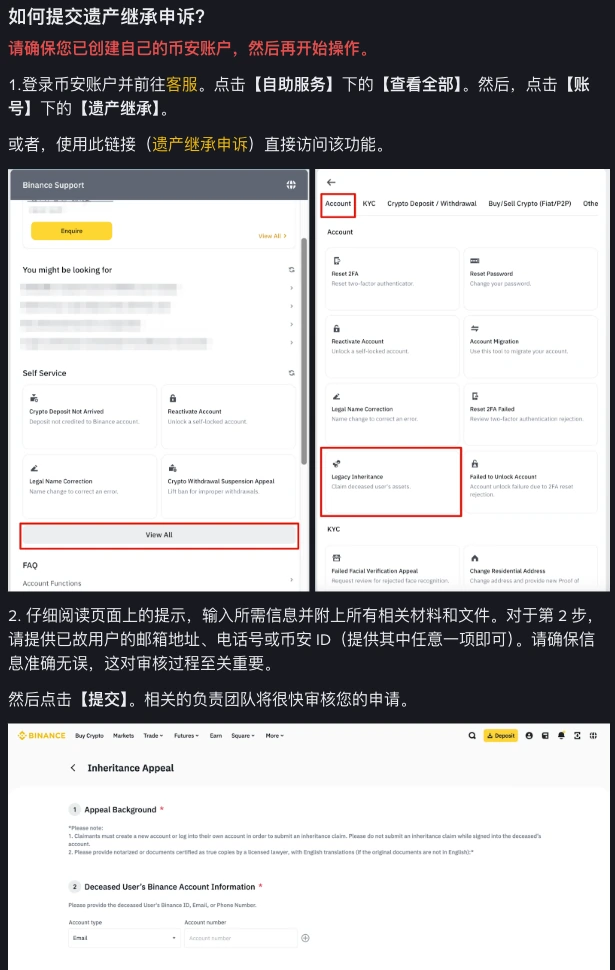
- Log in to your own account and go to Customer Support. Click View All under Self Service, then Legacy Inheritance under Account. The Inheritance Appeal link in that article opens the feature directly as well.
- Read the instructions on the page carefully and enter the deceased user's email, phone number or Binance ID. Any one of them is sufficient.
- Under Additional materials (required), upload certified copies of the four documents described in the next section.
- Under Additional Information (required), describe the inheritance claim. If a document could not be attached, give the reason here; the field is limited to 500 characters.
- Click Submit. A dedicated team at Binance reviews the application.
- Once the application details are confirmed, the deceased's assets are transferred to the rightful beneficiary or trustee.
The field names and requirements in steps 4 and 5 are taken from the form screenshot on the same page. The live form may not match it, so go by what the page shows when you file. The entry point and the field for the deceased user's details have illustrations of their own, in which the menu item is labelled Legacy Inheritance:
The four documents Binance asks for, all as certified copies
The form screenshot marks additional materials as required and lists certified copies of four documents:
- a legal document proving your right to claim the deceased's assets: a last will, a Letter of Administration, a certificate of inheritance, a Grant of Probate, or another legal document that establishes that right;
- the deceased's death certificate;
- the deceased's government-issued ID;
- your own government-issued ID.
A certified copy has a specific meaning on that form: notarized, or certified as a true copy by a licensed lawyer. Originals that are not in English need an English translation attached. A phone photo of the original has been through neither a notary nor a lawyer, so it falls short.
| Upload item | Requirement |
|---|---|
| Number of files | No more than 20 |
| Size per file | No more than 30MB |
| Supported formats | .jpg, .jpeg, .png, .mp4, .mov, .rmvb |
| Encrypted files | Do not upload |
PDF is not on the format list. If the notarized or lawyer-certified copy you receive is a scanned PDF, our suggestion is to convert it to .jpg or .png before uploading and to remove any open password first; as we read it, a password-protected file is one of the encrypted files the form says not to upload. If the upload page you see offers different formats, go by the page.
A death certificate or notarized inheritance certificate issued in mainland China is in Chinese, so the translation rule applies to it: it needs to be submitted as a notarized or lawyer-certified copy with an English translation attached. The form does not say whether the translation itself has to be notarized. Where to get this done and how many sets to prepare are questions for the local notary office before you start.
Two people's ID documents go into this upload, so it helps to know how Binance keeps identity documents and who can see them.
How long does a Binance inheritance appeal take?
The timing sits in the last step of the Help Center article, the transfer that follows confirmation of the application details: "it usually takes around 1 - 2 months to complete the process, but sometimes it may take longer in more complex cases".
The article does not say which account the assets arrive in, or whether they arrive in the original coins or converted. While you wait, watch for notices in your own account and at its registered email address.
Keep the originals, the certified copies and the translations together; if more documents are requested, you won't be starting again from nothing. Don't reply to private messages from anyone claiming they can speed up an inheritance review, and don't send photos of ID documents through chat apps.
Leave your family a list of your crypto accounts
An inheritance appeal starts from a detail that identifies the deceased's account. A family that doesn't know which platforms you have accounts on has nothing to put in that field. While you're alive, you can write them a list covering:
- which exchanges or platforms you have opened accounts with;
- which email address or phone number each account is registered under, plus the Binance ID where there is one;
- whether you have any self-custody wallets, and where they are kept (which device, which app).
Passwords and seed phrases stay off this list. A relative filing an inheritance appeal does it from their own account and has no use for the deceased's password. A list that included passwords would let whoever picked it up move the funds, and the list itself would become the risk.
Seed phrases need a separate arrangement. The Academy article's approach is to pair secure storage of private keys and seed phrases with a will. Its simplest option is writing them on paper and keeping the paper in a safe or bank vault, and it names damage, theft and loss among the risks of the storage methods it goes through. Who gets told where they are kept, and when, is something to settle as part of planning the will.
An exchange account you no longer use can be emptied or closed while you're alive, which shortens the list too. Before closing a Binance account, the assets have to be moved out and the records downloaded.
Write the list and hand it to your family
Platforms, registered emails and phone numbers only; no passwords, no seed phrases. Keep it where your family will find it, and tell them it exists.
For educational purposes only. Not investment, legal, tax or financial advice. This site is not an exchange, a wallet or a support channel, and will never ask for your private keys, seed phrase, verification codes or account login details.
Whose account to file from, and documents not in English
Does the relative need a Binance account of their own?
Yes. The appeal is submitted from the applicant's own account. Binance's Help Center article tells you to make sure you have created your own Binance account before you start, and a note at the top of the form says not to submit a claim from the deceased's account.
Can I log in to the deceased's Binance account with their phone and move the coins?
Our advice is not to. Binance has claimants file from their own account, not from the deceased's. A Binance Academy article also warns that accessing such accounts without authorization may constitute a criminal offense in some jurisdictions, and gives the Computer Misuse Act 1990 in England as an example. The route for the deceased's assets is the Inheritance Appeal.
Can I upload a death certificate that isn't in English as it is?
Not the bare original. The form screenshot on the Help Center page asks for certified copies, meaning notarized or certified as true copies by a licensed lawyer, with an English translation attached when the original is not in English. It allows up to 20 files of no more than 30MB each.